

In times of war, economies don’t just slow down, they fragment.
Supply chains break. Payments stall. Teams scatter. Markets shrink. Fear grows.
But something unprecedented is happening today, something that didn’t exist in past conflicts.
For the first time in history, entire economies can continue to function… without physical proximity.
This is not theory. This is the power of AI, cloud infrastructure, and borderless digital ecosystems.
The Shift: From Geography to Connectivity
Traditionally, economic resilience depended on geography, proximity to ports, infrastructure, and stable regions.
Today, resilience depends on something else entirely: connectivity and digital independence.
A company in Beirut can operate from Riyadh.
A development team in Amman can support a bank in Dubai.
A startup in Cairo can scale globally, even during regional instability.
War disrupts land. Technology bypasses it.
The Data Is Clear: Digital Economies Are More Resilient
This is not just a vision, it is backed by global data.
Across multiple crises, digitally mature economies and organizations have consistently outperformed their peers.
📊 1. Digital leaders recover faster
According to global consulting research, companies with advanced digital capabilities achieved 2 to 3 times faster recovery rates during major disruptions compared to less digitized organizations.
📊 2. Cloud-enabled businesses reduce downtime dramatically
Organizations leveraging multi-cloud and distributed infrastructure reported up to 70% reduction in operational downtime during regional or infrastructure-related disruptions.
📊 3. AI-driven companies outperform financially
Businesses that actively integrate AI into their operations see an average of 20–30% improvement in operational efficiency and significantly higher resilience under stress conditions.
📊 4. Cross-border digital services are accelerating
Digital services exports from the Middle East and emerging markets have been growing at over 2x the rate of traditional trade, signaling a structural shift away from geography-dependent economies.
📊 5. Remote-capable operations are now a necessity
More than 60% of companies globally now consider remote and distributed operating models as critical to their business continuity strategies.
What This Means for the Arab Region
The implication is powerful:
Resilience is no longer about avoiding disruption, it’s about designing systems that operate despite it.
In a region frequently exposed to geopolitical tension, this shift is not optional.
It is a strategic necessity.
The New Opportunity: A Digitally United Arab Economy
What if crisis could trigger collaboration instead of isolation?
The Arab world holds a unique advantage:
- Shared language
- Aligned cultural context
- Overlapping business ecosystems
- Rapidly growing digital infrastructure
Yet, these markets still operate in silos.
Today’s tensions present a new question:
What if Arab countries started functioning as a distributed digital economy?
Not politically unified, but technologically interconnected.
How AI Becomes the Backbone of Resilience
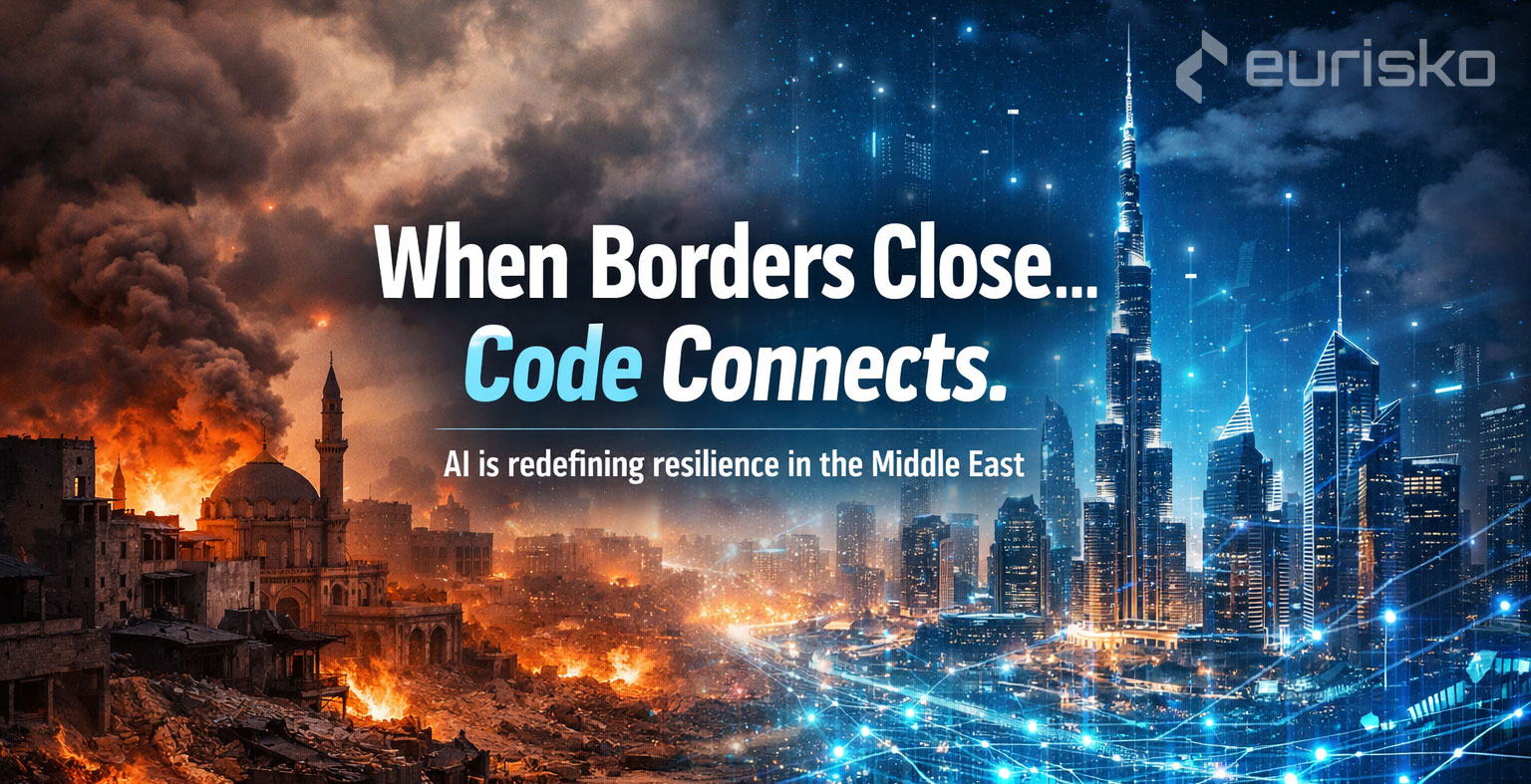
Artificial Intelligence is no longer just a productivity tool. It is becoming the infrastructure of continuity.
Here’s how:
1. Intelligent workload distribution
AI systems can dynamically shift operations across countries based on risk, availability, and performance, ensuring uninterrupted service delivery.
2. Smart customer engagement during crises
AI-driven platforms can adapt communication, offers, and services in real-time based on user sentiment, location, and risk exposure.
3. Autonomous operations
From customer onboarding to financial transactions, AI enables processes to continue with minimal human dependency.
4. Predictive risk management
AI can anticipate disruptions before they happen, rerouting operations, resources, and infrastructure accordingly.
The Role of Cloud and Infra-Agnostic Architecture
Technology alone is not enough. Architecture matters.
In a volatile region, dependency on a single infrastructure, vendor, or geography is a risk.
The future belongs to infra-agnostic platforms:
- Multi-cloud deployments across regions
- Decoupled microservices architectures
- Data replication across jurisdictions
- Zero-downtime failover strategies
In simple terms: systems that can “move” when the world around them becomes unstable.
From Survival to Strategic Advantage
Companies that adopt this model won’t just survive crises, they will outperform competitors.
Why?
- They remain operational while others pause
- They gain market share during instability
- They build trust through reliability
- They attract regional partnerships
Resilience becomes a competitive advantage.
A Call for Regional Collaboration
This is not just a technology shift. It’s a mindset shift.
Instead of reacting individually, Arab countries and businesses can:
- Share digital infrastructure strategies
- Enable cross-border service delivery
- Collaborate on AI-driven platforms
- Create regional digital alliances
In a fragmented physical world, unity can be built digitally.
The Silent Enabler
Behind every resilient system is a partner who understands both technology and uncertainty.
Not just how to build platforms, but how to design them for instability, scale, and continuity.
Organizations that embrace AI-driven, infra-agnostic, and resilient architectures today will define the region’s economic future tomorrow.
Final Thought
Wars will always test economies.
But this time, the outcome is not solely determined by geography, politics, or resources.
It will be determined by who can adapt fastest, and who can stay connected when everything else disconnects.
Because when borders close… code doesn’t.
About Eurisko
In a region where uncertainty is not an exception but a recurring reality, the ability to design systems that adapt, scale, and survive disruption is no longer optional.
Eurisko operates at the intersection of AI, digital platforms, and resilient architecture, helping organizations across the Middle East build solutions that are not tied to a single geography, infrastructure, or operating model.
By leveraging infra-agnostic development, cloud-native architectures, and AI-driven capabilities, Eurisko enables businesses to:
- Maintain continuity across multiple regions
- Scale operations dynamically based on demand and risk
- Deliver seamless digital experiences even during instability
- Future-proof their platforms against geopolitical and operational disruptions
From digital banking platforms to large-scale consumer applications handling millions of users, Eurisko’s approach is built on one core principle:
Technology should not just power growth, it should guarantee resilience.
In a world where disruption is inevitable, Eurisko helps organizations stay connected, operational, and ahead, no matter the circumstances.